Thomas Edison, one of the great inventors of our time, created a music player called the phonograph which played cylinders that were inscribed with music. Flat discs, better known as records, eventually took over and Edison was forced to give in and change his design. Now, after all these years, a new form of etched media was created as a marketing collaboration by Beck's record label project. What does it play you ask? It's a song by the N ew Zealand indie rock band Ghost Wave called "Here She Comes." Check out the full article courtesy of CNET here.
Hello there BrewGeeks. Temperature control is one of the last great frontiers to achieving the best homebrew possible, usually because it's not easy to dial in the perfect temperature. Cost and specialized knowledge can factor into how this is accomplished. A common method is to buy a freezer and hook up a johnson style controller to help maintain temperature. This device allows the brewer to set and maintain a temp by turning the freezer on and off. It works well, but does have a few shortcomings. First, a single-stage unit is focused only on cooling and does not connect to a heat source to raise the temperature when necessary. This means when it's set to, say 55 degrees, the actual temperature in the freezer can fluctuate within a range of as much as 5-7 degrees depending on its compressor and other factors. There is also no way to automate a fermentation schedule which is important when brewing certain styles and is also a great way make sure your beers finish where you want them to. You've seen our fermentation chambers that accomplish these goals but I'll be the first to admit that most homebrewers will not go through the trouble I did. Enter Caleb's Fermostat! With its intuitive interface and design, it takes the old style johnson controller to a whole new level! If he can get the support he needs through kickstarter, it could easily be the next great gadget for the serious homebrewer! Check out his funny video below and if you like what you see, head over to his kickstarter page to read more. Cheers! -TK
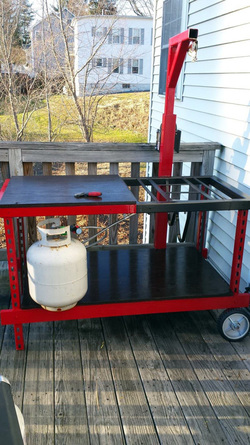
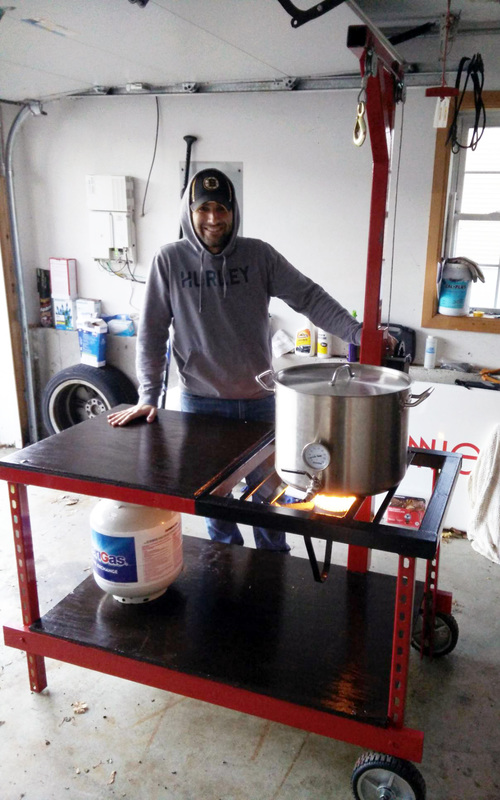
Brewing is a creative past-time where a good recipe is downright awe-inspiring. New homebrewers quickly realize that, although we stick to the basic rules, brewing techniques can vary and the equipment used can be just as motivational. kaeptnerdnuss demonstrates this here with the clever repurposing of a stainless BBQ grill that he calls the BrewBQ! Click the link below to check out the rest of his pictures. [ Read More]
Over at aul Kermizian, a child of the 80s (like pratically everyone in my circle of friends), chimes in on what classic 80's video games pair well with which beers. Here are a few for you.. click the link at the bottom for the rest.
Tapper with Sly Fox Helles Golden Lager or Victory All Malt LagerIn 1983's Tapper you control a mustachioed bartender who must serve wave after wave of increasingly surly patrons; cowboys, jocks, punk rockers, and, eventually, aliens. The game was originally, and somewhat controversially, branded with the Budweiser logo, but, says Kermizian, "we've always had the fantasy of hiring someone to reprogram the ROMs on our Tapper machines to have a craft brewery logo." As for a pairing, "There are a few nice Helles beers--light golden lagers made by American breweries that would go well." From Phoenixville, PA, Kermizian likes Sly Fox Helles Golden Lager, which Kermizian says "is really easy drinking--you could just see the aliens in Tapper pounding them." Golden Axe with B. Nektar or Redstone MeadWhether you decide to be Ax Battler, a Conan the Barbarian lookalike, axe-swinging dwarf Gilius Thunderhead, or Amazon Tyris Flare in this Medieval side-scrolling adventure game from 1989, Kermizian thinks you'd get into the spirit best by pairing gameplay with a mead. "We really love the meads from Redstone in Colorado and from B. Nektar Meadery in Michigan. You can drink it out of a glass, though originally it might have been from a goblet, or more likely from the bladder of a goat." Marble Madness with Dogfish Head Palo Santo MarronMarble Madness was one of the more unusual successes of the arcade era. In this game from 1984, the player uses a trackball to guide a marble through and over Miami Vice-hued mazes set on a black background. The object is simple, but gameplay is surprisingly challenging. Kermizian paired it with a similarly deceptive brew. "There are beers like Dogfish Head Palo Santo Marron, where people come in on a Friday night, and they think, 'Ahh, Dogfish Head--I want one of those.' But this one is 14 percent ABV, and it's pretty challenging. You've got to know what you're doing if you're going to drink a few of those. [Like] Marble Madness, it seems like this harmless, easy game, you're just trying to maneuver these marbles around a playing field, but it's pretty easy to find yourself going over the edge." [ Read More]
Are you sitting around wondering what your next DIY project will be? Look no further! Here's a relatively quick-n-dirty demonstration by TJPfeister on how to construct a mash rake. There's a link to his original article at the end of the full post and also be sure to stop by his club site Green Bay Rackers to see what else they have going on! You will need: - Two 3/4" x 36" pieces of poplar square stock (retails for ~$2.50 at local hardware stores)
- One 3/8" x 36" poplar dowel (retails for ~$1.00 at local hardware stores)
- A drill and bits
- Some sort of clamping device
- A saw
- A hammer
- Some finishing nails
- Diagonal cutters or something similar
- A small punch
- A means of measuring
Items that aren't required, but make life a little easier: - A drill press
- A finishing nail gun
- A mitre box
- An assistant
[ Read More]
Hey BrewGeeks fans! Sorry for the delay in blog posts. Although I don't have much time these days to find interesting things to post, I hope our fellow brewers find the rest of the information around the site useful. If you haven't looked around yet, check the sections to the left to get started. We will continue to add content down the road.If you are interested in being an editor for BrewGeeks and want to contribute by finding and posting articles, shoot us an email and we can talk about setting you up. In the meantime, please enjoy this engineering feat of awesomeness.
There are several ways to try ingredients before your brew day. Common techniques are tasting wort, chewing on grain SMASH beers or making a test batch. None of these approaches are ideal since making a batch that doesn't turn out as expected sucks and tasting wort isn't the same as a finished beer. In this tutorial, I will show you how to isolate different ingredients, in small batches, all at once. We will focus on five grains today, but there's no limit to the number of batches you can brew on a given day. But there's more! You can use this technique to test hops, different yeasts strains or to design a beer recipe! [ Read More] -Scoundrel
Thanks Jerry, for making us smile by sending over this great cartoon! You can check out more of his work by visiting JerryKing.com
There are a few different ways to carbonate beer in a keg and a number of factors to consider. How quickly does it need to be carbonated? Is the beer warm or cold? Let's first decide how carbonated we want our beer, then we can choose the best way to set up the equipment. The amount of CO2 in beer is measured by volumes and can vary slightly depending on the style. Around 2.5 volumes is pretty typical for most styles in the United States. Here's a chart that correlates beer temperature and PSI to help us out. You can see by the graphic that setting the regulator to 10 PSI with the beer temperature at 38°F will put it at 2.38 volumes. The next term to understand is equilibrium (sorry for the geek speak). This represents the minimum amount of pressure that is needed to maintain the gas disolved in the beer. In our example above, it usually takes about a week until the beer has reached this point. If the beer is warm, it will take longer for the CO2 to disolve at the same PSI. With these things in mind, there are two typical ways that homebrewers carbonate using CO2. Slow "Forced" Carbonating The first method, sometimes called "set and forget it", basically means that gas is slowly injected at whatever temperature and PSI you have set. Once equilibrium is reached, no more gas can be absorbed unless the PSI is increased or the temperature changes. Here are a few common scenarios: - 65°F (warm) at 27 PSI for about 10 days to hit 2.4 volumes.
- 37°F (cold) at 10 PSI for about 10 days to hit 2.4 volumes.
- 37°F (cold) at 35 PSI for 2-3 days to hit 2.4 volumes.
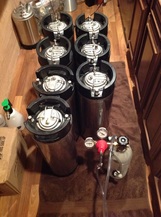
This last example is our preferred method of carbing. We use a small 5lb tank that easily fits in the keezer with the kegs. This is the fastest "non-shake" method of carbonating that we've found and it's nice because this extra time puts a little more age on the beer. Note that all connections must have tightened hose clamps or the tank will be empty in no time! Fast "Forced" Carbonating Although a bit less predictable, the other way to carbonate with CO2 involves shaking the keg while gas enters the beer and there are two schools of thought on this.
Some people shake with the gas line facing up (liquid side toward the floor) for fear of getting beer in the gas line. They typically set the regulator to 25-30 psi, connect the gas line to the cold keg, lay it flat to create the most surface area, then roll and shake the keg gently for about 20 minutes. Allow the keg to sit for a while and bleed off most of the gas before doing a test pour. Repeat if necessary.
Others find that setting the PSI to 40-50 prevents any backflow and the beer is shaken with the gas line at the bottom. This method has the benefit of listening for bubbles as CO2 enters the beer. The idea is to lower the pressure by 2-5 PSI each time the bubbles stop, then continue rocking the keg so the bubbles start again as the gas present goes into solution. Once the PSI on the regulator is around 20, the target pressure desired should be pretty close and near a good level of carbonation for serving.
I'm over carbonated... what happened??!! Both of these methods can lead to over carbonation and the beer must be tasted periodically to insure this doesn't happen. If it does, the solution is simple but can take time to solve.
Disconnect the gas and pull the pressure release value until the hissing stops. CO2 will come out of solution to re-pressurize the head space and be removed from the beer. Do this again every few hours until the desired volume is reached.
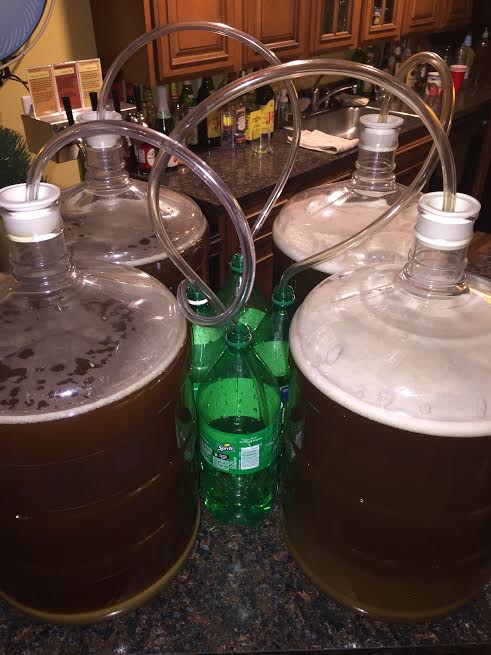
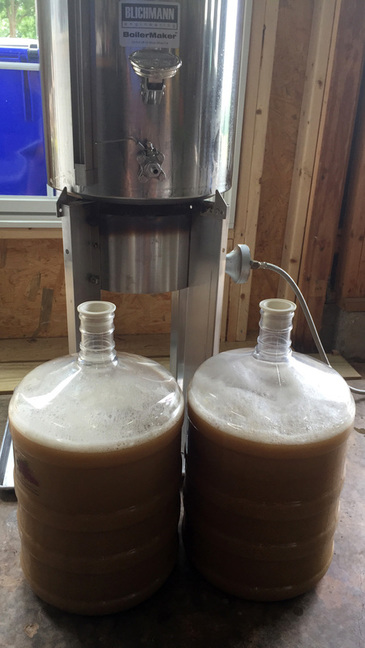
I submitted one beer to the National Homebrew Competition this year and it was an American Barleywine called "Hard Target". We've posted a few things about this beer in the past and if you missed it, the recipe and fermentation notes will bring you up to speed. One of the more interesting things about this beer was recorded in our " Add Oak And Bourbon To Keg" article where it was warm aged on oak and bourbon for almost a year. I was happy to find that the nylon bag held up quite well during this time. There was no deterioration at all and the stainless steel link chain was perfectly clean after running under water. The oak chips also showed very little wear. I'm extremely pleased with how this beer turned out and can't wait to see the NHC judging notes. I'll be sure to post up the score sheets when they come back (good or bad!). Eiswine say what?? On a side note, I fermented this beer in two 5 gallon carboys and they finished a bit differently. One of the carboys (the one I submitted) attenuated a little more and has a smoother, dry character. The second fermenter produced a sweeter version and, although some people would prefer it for the style, we ultimately decided that smoother was better.
Why did I mention this? Well, I have 4 gallons left of the slightly-sweet barleywine that may be a great candidate for a freezing process that concentrates alcohol and flavor. This process is typically used to create the strongest member of the bock family called an "Eisbock".
Eisbock, which is German for "icebock", is made by freezing the beer into a slushy consistancy, effectively removing water from the beer. As it concentrates, the bitterness, final gravity and color are all boosted.
I'm freezing a test sample soon, just to be sure it works for this beer. I'll try to post a write-up of the sample tasting and definitely the full process if we do it.
p.s. My buddy Scoundrel submitted 3 beers this year and I certainly wish him luck and hope his beers find the second round!
Gooooo BREWGEEKS!
Cheers!
TK
|